Did you know the single best "educational toy" for your two-year-old might already be sitting in your kitchen, costing you nothing? Before you spend ₹3,000 on a glossy imported puzzle, look at your dal dabba, your steel katoris and your old chimta. A Montessori teacher would see a complete learning lab.
Dr Maria Montessori discovered something simple but powerful: young children learn best through their hands, with real, concrete objects — not screens, not flashing plastic. In fact, one of the core principles of good early-childhood teaching is "concrete to abstract": let a child touch and count five real rajma beans before you ever show them the number "5" on paper.
Here are ten Montessori-inspired activities you can set up today using everyday Indian household items. Most take under five minutes to prepare.
Why everyday items beat fancy toys
In our teacher-training notes, we teach that children learn through seeing, hearing, touching, tasting and smelling — what we call perception. Real objects engage all the senses. A plastic toy apple cannot be smelled or tasted; a real one can. Everyday items also carry a quiet message to your child: you belong in this home, this is your world too.
Give a child a real task with real things, and you give them the gift of "I can do it myself."
Practical life: the heart of Montessori at home
Montessori called these "practical life" activities. They build concentration, independence and fine motor control — the same small hand muscles your child will later need to hold a pencil.
1. Spooning dal. Give two katoris, one with moong dal, one empty, and a spoon. Let your child transfer the dal from one bowl to the other. Spills are part of learning — keep a little jhadu nearby and let them sweep up too.
2. Pouring water. Two small steel glasses and a little water on a tray. Pouring without spilling is deeply satisfying work for a toddler and builds hand control and focus.
3. Tong transfer with a chimta. Use a small kitchen tong or even an old roti chimta to move walnuts or boiled eggs from one bowl to another. This strengthens the exact grip needed for writing.
4. Folding napkins. Hand your child clean handkerchiefs or small towels to fold. Folding along a line teaches order, neatness and patience.
Sorting and counting with pulses and spices
These activities quietly build early maths and the thinking skill of classification — comparing, grouping and finding relationships.
5. Sorting pulses. Mix rajma, chana and moong in a bowl and give an ice tray or three katoris. Ask your child to sort each pulse into its own section. (Always supervise so nothing goes near the nose or mouth.)
6. Counting with beans. Lay out number cards 1 to 5 and let your child place that many kidney beans below each. They are feeling numbers, not memorising them — the deepest kind of maths learning.
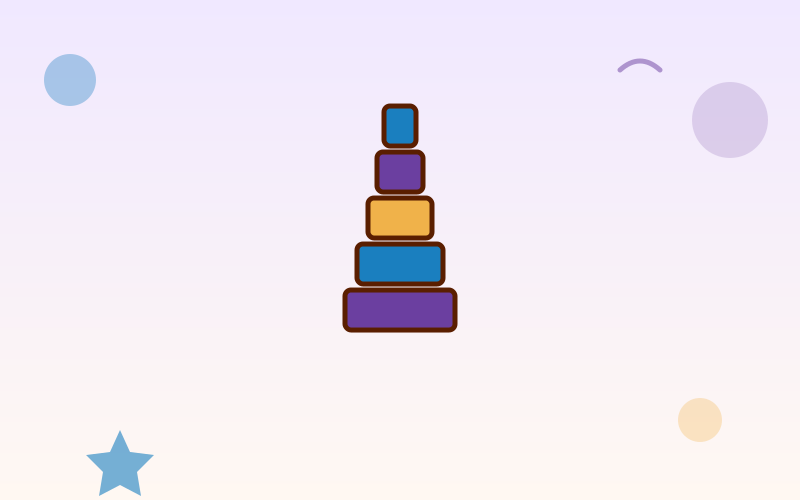
7. Big, medium, small. Line up three steel katoris of different sizes and let your child nest them. Concepts like big/small and more/less are foundational cognitive skills, and your kitchen teaches them for free.
Sensory and language activities for everyday play
8. The smelling game. Take small bowls of jeera, elaichi, hing and dhania. Let your child close their eyes, smell each one, and guess. This sharpens the senses and builds vocabulary in the most delightful way.
9. Texture treasure basket. Fill a basket with safe objects of different textures — a coconut, a steel spoon, a soft cloth, a wooden belan. Babies and toddlers explore them freely. This is pure sensory learning, and it keeps little ones absorbed far longer than any video.
10. The colour and fruit walk. Take a katori of real fruits — a banana, an apple, a few grapes. Name each, talk about its colour, let your child touch, smell and taste. This is exactly how trained teachers run a "Fruits" lesson: naming, sorting by colour, and singing "Apples are red, bananas are yellow…" You can do the very same at your kitchen table.
A few gentle rules to make it work
- One activity, one tray. A calm, uncluttered set-up helps your child concentrate.
- Let them struggle a little. Do not jump in to fix it. The effort is the learning.
- Repetition is good. A child may spoon dal twenty times. Repetition builds mastery and confidence — let them.
- Praise effort, not just success. "You worked so carefully!" matters more than "Good job."
- Always supervise with small items like beans and spices.
You will notice something within a week. Your child concentrates longer, asks to "help" in the kitchen, and beams with that "I did it myself" pride. That glow is not just cuteness — it is genuine cognitive, emotional and physical development happening right in front of you.
Ready to take the first step?
If setting up these little trays lit something up in you — that quiet joy of watching a child learn — you may have a natural teacher's heart. At the Toddler Teachers Training Institute in Nagpur, our Diploma in ECCEd shows you dozens more activities like these, the child development behind why they work, and how to make beautiful low-cost teaching aids yourself.
Try a free demo class (online across India, or in our Bajaj Nagar classroom) and experience it for yourself. You can explore the ECCEd diploma, or message us a friendly "Hi" on WhatsApp at +91 70206 06285. New batches begin July 2026 — and a home-delivered study kit comes with every admission.

Written by
Mrs. Avanti Jodhpurkar
Founder & Director, Toddler Teachers Training Institute
Mrs. Avanti Jodhpurkar has spent over 13 years training early-childhood educators across India. She founded Toddler Teachers Training Institute in Nagpur with one belief: that any woman who loves children can become a confident, qualified teacher — whether she is starting fresh or restarting after years at home.
Curious to learn more?
Book a free demo class and see how the ECCEd diploma works — no fees, no pressure.
Book a Free Demo